
![]() |
|
|
|
|
The Case for Equal Marriage
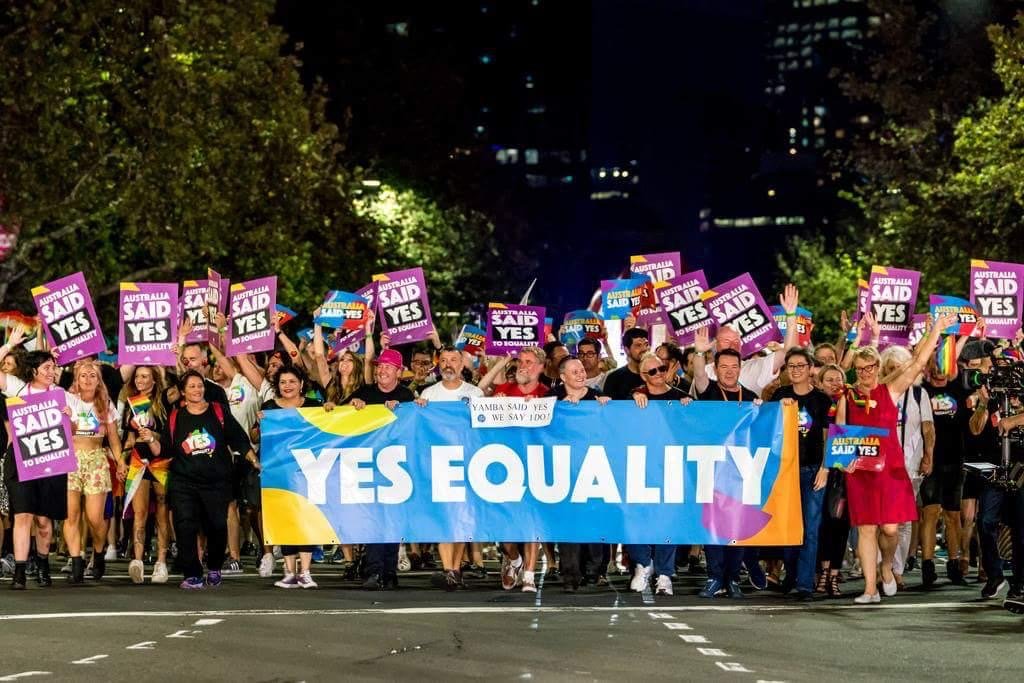
Instead of sending a message that all Australians are to be treated fairly and equally, regardless of their sexual orientation, the message currently being sent by our federal law is that it is acceptable to exclude lesbian, gay, bisexual and transgendered persons from a central social institution and that our relationships are inferior. In recent years, most state and territory governments, have extended to same sex couples many, though not all, of the legal and economic rights and responsibilities available to opposite sex couples. Yet we remain excluded from the institution of marriage itself, a distinction that undermines our human dignity, diminishes our families and discriminates against us in violation of our basic right to equal legal treatment. Providing same sex couples with the equal right to marry will not harm religious institutions in any way. Each religion will still have the right to choose whether or not to perform marriages for same sex couples. Religions that wish to perform marriages for same sex couples should also have the freedom to do so. Some opponents of equal marriage have suggested that marriage as an institution would be weakened, even tainted, by our presence. Such people are, of course, free to hold whatever views they wish in respect of homosexuality and the treatment of same sex couples, but Australian law should not be based upon such degrading and offensive notions. No group of Australians should be systemically excluded from any legal institution, let alone one as central to our society as legal marriage. It must be open to all Australians, regardless of their sexual orientation. Some day, same sex couples in Australia will have the legal right to marry. That is inevitable. As with every major human rights advance, from the abolition of slavery to allowing women to vote, future generations will look back and wonder how anyone could have opposed such a basic human right. Same sex couples have and raise children. Allowing these couples to legally marry affords their children the same protections and benefits as children raised by opposite sex parents. For many Australians, marriage uniquely conveys the nature and legitimacy of a committed romantic relationship. Gays and lesbians should not be denied this form of expression. Language does not merely reflect discriminatory social attitudes and practices, but is involved in shaping and perpetuating such attitudes and practices. The exclusion of same sex relationships from marriage and the invention of a different word to describe our unions represents gays and lesbians, and our relationships in particular, as deviant and abnormal, and as less worthy than heterosexual unions. Marriage is a part of Australian life and same sex couples, in fact all lesbian, gay and bisexual persons, are constantly faced with the fact of our exclusion from it. It's not a pleasant feeling. Because there is greater social reluctance to recognise the legitimacy of same sex relationships, the benefit of automatic recognition that marriage confers is particularly important for lesbian and gay couples. When a same sex partner is injured, the last thing the other partner needs is to have the legitimacy of the relationship questioned by hospital authorities. When a child is hurt on a school trip, and the biological parent is unavailable, the co-parent does not want to have to convince a schoolteacher that the relationship is valid. When a same sex partner dies, the surviving partner does not need to have the grief of loss compounded by having to prove that he or she is authorised to make the funeral arrangements. In a married relationship, these matters are rarely called into question, and the validity of the relationship can be easily demonstrated if necessary through production of the marriage certificate. Australia is a country where individuals are afforded the right to choose their own religion and their own philosophy of life, the right to choose with whom they will associate and how they will express themselves, the right to choose where they will live and what occupation they will pursue. The government should respect choices made by individuals and, to the greatest extent possible, avoid subordinating these choices to any one conception of the good life. Our choice to marry should not be denied because we are not heterosexual. In Australia, same sex couples, and all gay, lesbian, bisexual and transgendered persons for that matter, still suffer under the weight of stigma and prejudice. While much progress has been, we are still often subject to verbal and physical assaults, many of us still grow up in isolation and fear and kids who are not heterosexual still face significantly higher suicide rates than their heterosexual counterparts. These attitudes of prejudice are reinforced – and given State sanction - by discriminatory laws. Prime Minister John Howard argued that preventing same sex couples from marrying was 'a matter of survival of the species'. Clearly, the ability or desire to have children is not a prerequisite to marriage. Opposite sex couples can get married whether or not they are able or willing to procreate; same sex couples are prohibited from marrying, whether or not they are raising children. “Companionate” marriages between elderly heterosexuals past the age of child-bearing are celebrated and affirmed in our society, not banned under law. Civil unions or registered partnerships can provide some or all of the rights and obligations of marriage. AME has no objection to civil unions or registered partnerships as a supplement to marriage, but as long as we are denied the equal right to marry, alternative regimes do not fix the discrimination. Australia would not be the first to take this step, and it will not be the last. Same sex marriage is already a reality in the Netherlands, Belgium, Spain and Canada.
Hasn't marriage
been opposite sex for thousands of years? How can
this be discrimination? More fundamentally, however, the historical exclusion of same sex couples from marriage cannot be used to justify the continuation of our exclusion on the basis of an appeal to "tradition". Discriminatory treatment and exclusion is no less damaging because it has a longstanding pedigree. Sexism, slavery, racism, persecution of religious minorities – all have existed for thousands of years, all have been perpetuated at one time or another by governments and all are now recognised as discrimination. If appeals to the past could be used to perpetuate the marginalisation of disadvantaged groups, there would be no end to injustice. The institution of marriage has itself evolved over time to accommodate the needs of equality. From a time when women were treated as the property of their husbands, interracial marriages were prohibited, and only dominant religions had the right to marry, marriage has changed to recognise that values of equality enhance, rather than diminish, the institution.
Expanding marriage to include us wouldn't change what marriage is all about any more than allowing women to practise medicine changed what being a doctor meant. It merely expands the class of people to whom marriage is open.
Traditional marriage
will not be weakened by permitting same sex couples
to marry. People don’t turn away from marriage
because others who are eligible to marry do not meet
their particular moral standards. It seems unlikely
that any opposite sex couple would turn away from
marriage just because same sex couples can marry.
|
||||||||||||||||||||
|
|
| Copyright © 2008 Australian Marriage Equality Inc. |